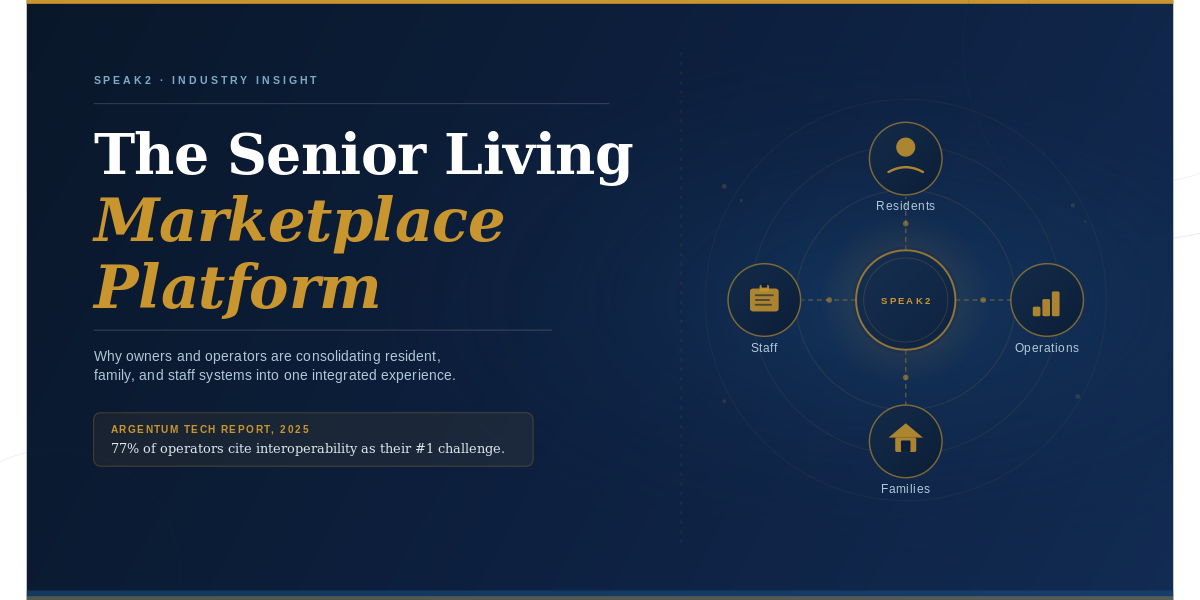
Speak2 · Industry Insight

The Senior Living
Marketplace Platform

Why owners and operators are consolidating resident, family, and staff systems into one integrated experience — and what it means for the entire ecosystem.

A Tale From the Front Lines


Thomas used to work in banking, where everything ran on modern, connected systems. Data was accessible, decisions were defensible, and information moved in real time. He wanted a change — something more meaningful — so he took a job in senior living.

What he found was not what he expected.

Every day, Thomas logged into five separate systems just to do basic parts of his job: one for resident care, another for billing, an "engagement" platform, another for staffing. And even then, critical information fell through the cracks — tracked on paper, passed in hallway conversations, or simply lost.

What felt personal at first began to feel chaotic. Staff were rewriting the same information, texting updates on WhatsApp, and spending precious time on manual workarounds instead of caring for residents. When ownership asked how things were going, Thomas struggled to pull together reports. The data was scattered, inconsistent, or missing entirely.

"Thomas didn't want anything complicated. He just wanted one system that brought everything together. A single place where teams could work, share information, and understand what was really happening."

He is not alone. Thomas's story is the story of nearly every operator in senior living today. And it is the problem a marketplace platform was built to solve.

The Fragmentation Problem


Most communities didn't design fragmented systems — they accumulated them. As technology became more expected, operators adopted solutions to solve individual problems: resident engagement, dining, transportation, maintenance, forms, EHRs, and CRM.

While well-intentioned, the result was not digital transformation. It was digital fragmentation.

77%
of senior living executives cite interoperability as a primary challenge
74%
view compatibility with existing infrastructure as a critical barrier

Source: Argentum Technology Report, 2025

Each additional system carries a measurable cost: duplicate data entry, manual reconciliation, low adoption, inconsistent communication, training fatigue, and a growing gap between leadership intent and frontline execution.

Fragmentation is not just inconvenient. It is expensive, demoralizing, and it quietly erodes the experience you've promised residents and families.

What a Marketplace Platform Actually Means

A marketplace platform is not just a resident app. It is a single front door to services and community life — with role-based experiences built for every stakeholder.

For Residents
  • Schedule transportation, maintenance, and service requests in seconds
  • See real-time status on every request — no more "Is that taken care of?"
  • Two-way communication with staff, personalized to their preferences
  • A consumer-like hospitality experience — not a bulletin board
For Families
  • Full transparency into community life — activities, communications, updates
  • Access to forms, billing, and service requests in one place
  • A communication channel that relieves the "Does my parent have what they need?" anxiety
  • Increased trust that directly reduces move-out risk
For Staff
  • A centralized request queue with task prioritization and measurable accountability
  • Cross-department visibility that eliminates duplication and miscommunication
  • Less paper, fewer phone calls, and no more "WhatsApp chains" as a workaround
  • Tools that match what staff expect from modern employers — reducing burnout and turnover

The Hidden Cost of Fragmented Systems


There is a dangerous trend emerging in senior living that other industries abandoned decades ago: the promise of "integration" as a solution. In the 1990s and 2000s, firms sold expensive integration projects across fragmented industries. The lesson was clear and hard-won: integration is not a strategy. It is a band-aid.

Modern systems are built on an API-based economy. Getting data in and out should be straightforward and free. The fact that so many senior living systems cannot integrate easily is not a feature gap — it is a red flag about the age and architecture of those platforms.

Fragmentation creates "silent financial leakage" — costs that don't appear on any invoice but are paid every single day through wasted time, frustrated staff, and missed opportunities.

Five Cost Centers You May Not Be Measuring

1 · Labor Inefficiency

  • Time lost to logins and navigation
  • Duplicate documentation across systems
  • Manual workarounds consuming hours each week

2 · Vendor & IT Overhead

  • Multiple contracts and renewal cycles
  • Integration costs and support tickets
  • Endless training as systems change

3 · Adoption Failure

  • Staff revert to paper and hallway conversations
  • Residents don't remember which app does what
  • Leadership loses visibility entirely

4 · Data Silos

  • Which services drive retention? Unknown.
  • Where is staff time going? Unknown.
  • Who is disengaging early? Unknown.

5 · Reputation Damage

  • Residents and families evaluate senior living like any other service industry
  • Disconnected digital experiences reduce trust, increase complaints, and drive referral loss
  • In an era of online reviews, a broken experience is a public experience

The ROI Case for Consolidation


ROI is not theoretical. It is operational and measurable. A marketplace platform delivers return through four primary channels — each of which can be defined, tracked, and reported.

1

Revenue Protection Through Longer Length of Stay

Length of stay is one of the most powerful financial levers in senior living. Even small improvements produce outsized returns. The more embedded a single platform is in daily life, the more "sticky" your community becomes.

Operators using Speak2 consistently report higher resident participation, faster service response times, improved family visibility, and a meaningfully stronger perception of community value.

This is the largest hidden ROI in senior living. It doesn't appear as a line-item cost reduction. It shows up as improved stability, less incentive spend, and revenue retained — without increasing your marketing budget.

Protecting even one resident from an early move-out can be worth more than six months of technology spend. That's not a margin improvement. That's a business case.

2

Labor Efficiency and Capacity Expansion

Speak2 consolidates high-frequency workflows: service requests, dining coordination, maintenance, transportation, communications, and more. The goal is not to replace your people. It is to give them back time.

Recovering just 30 minutes per care staff member per day has an enormous compounding impact. That recovered time can be redeployed to relationship building, resident engagement, and proactive care that leads to retention.

This is capacity expansion without additional hiring. Quantifiable time savings can be tracked across concierge, activities, dining, maintenance, care coordination, and the business office.

3

Vendor Consolidation and Total Cost Reduction

Owners consistently underestimate the true cost of managing multiple point solutions: overlapping features, separate renewal cycles, layered support costs, fragmented training, and redundant IT overhead.

Fewer vendors means more visibility into your actual technology ROI. It means fewer contracts to manage, more consistent user interfaces, unified communication, and greater buying power. And it eliminates the most insidious cost of all: paying for features that nobody uses because nobody adopted the system.

4

Portfolio-Level Intelligence

When your data lives in one place, you can finally answer the questions that matter most at the ownership level — without launching an IT project.

  • Which communities are outperforming on retention, and why?
  • Where are operational bottlenecks repeating across properties?
  • Which services are driving engagement — and which are invisible to residents?
  • How does activity participation correlate with length of stay?

The strongest ROI models are built on consistent, accessible data. A consolidated platform makes executive KPIs measurable in real time, not in quarterly reports assembled by hand.

Practical Next Steps


The path to a consolidated platform begins before the platform is selected. Operators who build a clear baseline and define success metrics in advance consistently see faster adoption and stronger ROI.

Step1

Establish Your Baseline (60–90 Days Pre-Platform)

  • Occupancy and move-in velocity
  • Average length of stay by care level
  • Staff time spent on service requests (from request to resolution)
  • No-show rates for activities and transportation
  • Family inquiry volume and common complaint categories
  • Number of systems used by frontline roles
Step2

Model Benefits Conservatively

  • Conservative: modest time savings, minimal length-of-stay improvement
  • Expected: moderate adoption, meaningful operational gains
  • Optimistic: high adoption combined with full workflow redesign
Step3

Prove Adoption — Because ROI Depends on It

  • Percentage of residents active weekly
  • Percentage of families active monthly
  • Staff weekly active users by department
  • Service request volume captured in-system vs. off-system
  • Response time improvements by category
Step4

Tie Activity to Financial Outcomes

  • Incremental resident months retained (length of stay)
  • Labor hours recovered across departments
  • Vendor cost savings from consolidation
  • Reduction in refunds, credits, and avoidable service recovery costs

ROI happens when workflows change — not when a tool is merely available. Executive involvement drives adoption. Adoption drives outcomes. Outcomes drive ROI.

Conclusion


Every owner in senior living will eventually face the same question: do we keep accumulating systems, or do we build a platform? The answer, increasingly, is not a matter of preference. It is a matter of survival.

The residents moving into your communities today are not the residents of a decade ago. They are experienced technology users — Amazon customers, Uber riders, OpenTable diners. They expect personalization, transparency, and responsiveness. Not a paper activity calendar and a phone call to check on a maintenance request.

Their families are even more demanding. One difficult experience, one moment where they couldn't reach staff or didn't know if their parent had what they needed, is enough to plant the seed of doubt that leads to a move-out conversation.

And your staff — the people who carry your mission every single day — deserve tools that match the standard of their work. Retaining great staff is now inseparable from offering great technology. Turnover is one of the most destructive forces in senior living operations. A platform that empowers staff is not a luxury. It is a retention strategy.

Three Truths for Owners

1

Fragmentation has a price. It may not appear on your P&L, but it is being paid — in staff time, in family trust, and in residents who leave earlier than they should.

2

Consolidation is not a technology decision. It is an operational and financial decision. The platform is the vehicle. The outcomes are the destination.

3

The communities that will win the next decade are those that build an ecosystem — one where residents feel known, families feel informed, and staff feel supported. That is not a vision statement. That is a competitive advantage.

Thomas's story does not have to be your story. The technology exists. The model is proven. The ROI is measurable. What is left is the decision — not to adopt another tool, but to build the platform your community deserves.

When your systems work together, your people work smarter. And your residents, families, and staff experience the community you always meant to build.

Ready to see the platform in action?

Speak2 offers a structured discovery process including an ROI analysis specific to your community portfolio.

Visit speak2family.com